Saturn is the sixth planet from the Sun in our Solar System, and the second largest planet after Jupiter. It is named after the Roman god Saturn, equated to Cronus, the Titan father of Zeus in Greek mythology, also equated to the Babylonian Ninurta and the Hindu Shani. Saturn’s symbol represents the Roman god’s sickle (♄).
Saturn is a gas giant, just like Jupiter, Uranus and Neptune. These four Planets are often referred to as “Jovian”, meaning “Jupiter-like”. Saturn’s average radius is 9 times larger than Earth’s. Even though its density is only 1/8 of our home planet, due to its larger volume Saturn’s mass is 95 times the Earth’s. This huge mass difference creates an environment considered really extreme compared to Earth’s. If we leave Saturn however, and visit its satellites, we can find very earthly-like places. Saturn’s most remarkable feature is that it has nine rings, consisting mostly of ice particles and dust. Even though these rings make Saturn so easily recognizable, it was its moons that attracted the most interest both from scientists and the world of literature, through science-fiction.
 |
| 1 The Moons of Saturn |
There are 62 recognized moons orbiting the Planet (pic. 1), from which 52 are officially named. They range from the size of tiny to bigger than the smallest Planet in our Solar System. These icy moons vary in shape and age as well, not to mention their origins. Some of them have a rough, hard surface while others just porous bodies covered in ice particles. Most of them are named after characters from ancient mythology, titans and titanesses, in connection with the also mythological Saturn. The largest natural satellite in our Solar System also orbits Saturn, the mighty Titan.
 |
| 2. Titan |
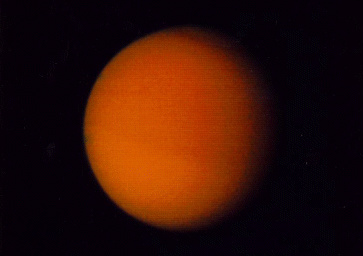
Titan (pic.2) is the most Earth-like place in the Universe we found to date. It was discovered by the Dutch astronomer Christiaan Huygens in 1655, with his own made telescope. Titan is larger than Mercury, the smallest planet in the Solar System, and is the only moon with a dense atmosphere. Before space exploration however, it was really hard to examine the surface due to a naturally produced photochemical smog which obscured it. Its observation only started after 2004 when the spacecraft ‘Cassini’ arrived near Saturn. It has revealed that Titan’s surface is shaped by rivers and lakes of liquid ethane and methane, which also results in the forming of clouds and rains, just like water does on Earth. Winds shape dunes on the surface, and volcanic activities in the form of liquid water were also recorded. Cassini carried the European-built Huygens-probe as well, which landed on the surface, sending stunning images and measured data back to Earth. As this mission progresses, they will monitor seasonal changes and measure further data that would help us understand Titan and also the early phases of Earth.
The Cassini mission not only studied Titan, it also brought another moon of Saturn in the point of interest, Enceladus. It has shown to have a towering plume of icy particles at its south pole, also has geological activities, simple organic compounds and possibly liquid water under its surface, which makes it very important in the study of possible environments for life.
 |
| 3. Lapetus |
Another very interesting moon of Saturn is the strange black and white natural satellite: Lapetus (pic. 3) was discovered by Giovanni Domenico Cassini in 1671. It is the second known moon of Saturn, after that another three moons were discovered also by Cassini. Lapetus is one of the interesting moons’ of Saturn, due to its remarkable feauture of having both a bright side like snow and black side like velvet. The theory for the dark side of Lapetus is thermal segregation. Lapetus has a very slow rotation of more than 79 days, which means that the daily cycle of temperature is very long. The dark material on the surface of the moon absorbs the heat from the Sun and warms it up (more, than the bright side). This heating causes volatile or icy species in the dark material to sublime out and retreat to the colder regions on Lapetus. As a consequence, the dark material become darker and the other side brighter (cold regions become brighter). Another important feature of Lapetus is its “equatorial ridge”, which is a 10km long chain of high mountains. On the anti-Saturnal side of Lapetus, bright mountains can be seen.
As space exploration evolves we will get to know more and more about Saturn itself and the moons orbiting it, which will not just help us to understand our origins on Earth and our planet’s past itself, but also opens up a more complex and interesting view about the Universe and its features as well.
References:

No comments:
Post a Comment